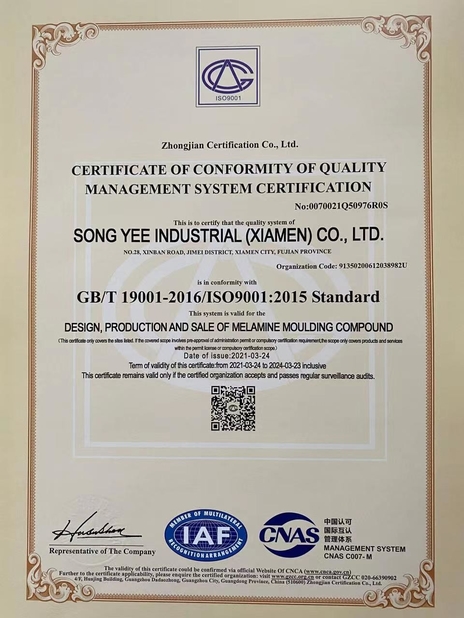
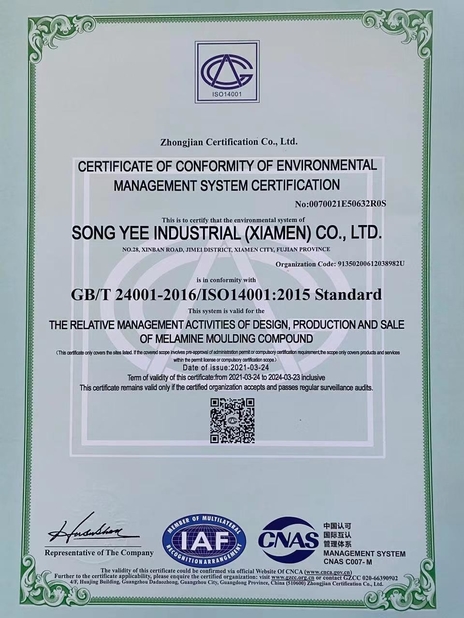
[City], China — November 26, 2026 — Melamine dinnerware buyers have become noticeably more specific over the past two years. Where purchase orders once said only "melamine powder," they now name the grade: A5. The shift is driven less by marketing than by compliance — food-contact regulations in the EU, the US and China all treat the resin base of a tableware article as a regulated input, and urea-blended compounds are increasingly difficult to defend in a migration test.
This note sets out what A5 grade actually means, what a 100% melamine amino resin compound delivers on a production line, and what factories should verify before switching grades.
What "A5" Actually Specifies
A5 is a tableware grade of melamine-formaldehyde moulding compound. In practice the grade designation describes two things at once: the resin chemistry and the flow behaviour.
The chemistry is the decisive part. A5 is based on 100% melamine resin with no urea-formaldehyde (UF) blending. Lower grades — typically A1 and A3 — are cost-reduced by adding urea, which lowers the raw material price but introduces a resin that is not intended for direct food contact and produces a duller, softer, more yellowing surface.
The flow behaviour is the practical part. A5 is formulated for the flow length and cure speed that full-set dinnerware requires: plates, bowls, trays, mugs and deeper items moulded on multi-cavity tools where a short shot means scrap.
A Reference Specification
Published figures vary by supplier, so the values below are a working baseline rather than a purchase commitment. Always confirm against the Certificate of Analysis for the lot you receive.
| Property |
Typical A5 value |
| Resin base |
100% melamine-formaldehyde, no UF blending |
| Melamine content |
≥ 99.8% (resin basis) |
| Appearance |
Fine, free-flowing white / off-white powder |
| Whiteness |
≥ 95 |
| Moisture and volatile |
≤ 0.2% |
| pH |
7–8 |
| Flowability |
180–200 mm |
| Curing temperature |
145–165 °C |
| Curing time |
30–90 s, by wall thickness |
| Flexural strength |
≥ 80 MPa |
| Water absorption |
≤ 0.5% |
| Heat deflection |
≥ 155 °C |
| Packaging |
25 kg kraft bag, PE inner liner |
| Shelf life |
12 months, sealed and dry |
Four Things A5 Changes on the Line
1. Fewer compliance surprises. Because the resin contains no urea, the formaldehyde and melamine migration profile after correct curing stays inside the limits set by FDA 21 CFR 177.1460, EU 10/2011 and GB 4806.6. That does not make compliance automatic — an under-cured part can fail even with compliant powder — but it removes the most common root cause of a failed test.
2. A shorter, more repeatable cycle. A5 cures in roughly 30–60 seconds at 145–165 °C for thin-wall items, and 60–90 seconds for thick sections. Uniform flow from batch to batch is what makes those numbers stable: fewer short shots, less flashing, less manual trimming, and a lower scrap rate on a high-cavity mould.
3. A finish that needs less work. Fine particle distribution and pre-dispersed pigment give a dense, pin-hole-free, high-gloss surface straight out of the tool. For set-based programmes — where eight plates and eight bowls must match — batch-to-batch shade consistency matters as much as gloss, and it is the reason colour discipline belongs in the supplier audit, not just in the colour card.
4. Less post-mould correction. A5 parts demould cleanly and hold their shape, with shrinkage in the 0.6–0.7% range that mould designers can plan around. Warping and yellowing complaints drop once the grade is fixed and the preheat stage is controlled.
Where A5 Is Used
Plates, bowls, trays, cups and mugs; children's dinnerware; hotel and restaurant service pieces; catering and buffet ware; picnic and outdoor sets; promotional and gift sets; and melamine components for kitchen appliances.
The pattern is consistent: A5 is specified wherever the article touches food, or wherever the surface finish has to survive retail scrutiny.
What to Verify Before You Switch
Grade claims are easy to make. Verification is what separates suppliers, and buyers are now asking for four things as standard:
• A lot-level Certificate of Analysis covering purity, moisture, flow, whiteness and free formaldehyde — not a generic specification sheet.
• Test reports for the finished article, including migration testing after the cure profile you actually run, since powder compliance alone does not cover the moulded part.
• Retained samples per lot, so a shade or flow dispute can be resolved from evidence rather than memory.
• A documented cure window. A supplier who cannot tell you the safe cure range for your wall thickness has not done the application work.
A practical check that costs little: request 1–2 kg, run it on your own tool at your own preheat setting, and compare scrap rate and gloss against the grade you use today. Flow and cure can be adjusted within a defined window to match a specific press and cycle, and that adjustment is usually the difference between "works" and "works well."
Supply and Availability
A5 compound ships in 25 kg kraft paper bags with a PE inner liner, moisture-proof and palletised, at roughly 18–20 MT per 20-foot container; neutral packing or buyer-branded bags are both common. Typical lead time is 7–15 days after deposit, longer for Pantone-matched colours. The material carries HS code 3909.20 and a 12-month shelf life when stored sealed below 30 °C, away from direct sunlight.
FAQ
Is A5 the same as "100% melamine"?
In trade usage, yes: A5 denotes a compound built on 100% melamine resin with no urea-formaldehyde blending. The compound still contains alpha-cellulose as a filler, which is normal and permitted for food-contact moulding compounds — "100% melamine" refers to the resin base, not to a filler-free powder.
Can A1 or A3 be used for food-contact tableware?
They are not intended for it. A1 and A3 are urea-blended, cost-reduced grades aimed at non-food-contact or economy items, and they are a poor fit for markets that test migration.
Does a compliant powder guarantee a compliant plate?
No. Migration depends on cure. Under-cured articles can exceed limits even when the incoming powder passes. Compliance has to be demonstrated on the finished part, under the production parameters actually used.
Can flow and cure speed be customised?
Yes, within a defined window, to suit machine tonnage, cavity count and target cycle time. Buyers should supply those three details when requesting a match.



 Vietnamese